
No Mosque Nearby? How Muslims in Small US Towns Teach Quran to Their Kids
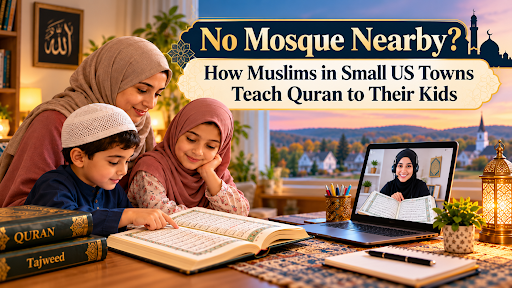
Being a Muslim in a small American town presents some challenges. One of the most difficult is locating a good Quran teacher if there are no mosque or Islamic center in the vicinity.
Muslim families in major cities such as New York City, Chicago and Houston may have multiple choices for Quran learning. What about if you were living in a quiet town with a mosque that’s an hour away? What if your children have never been to a Weekend Islamic School?
These are common concerns for Muslim parents. To ensure that their children read the Quran properly, grasp Islamic values and develop a strong bond with Islam.
Fortunately, not living close to a mosque doesn’t imply that your children won’t get any Quran education. Simple daily activities and with some encouragement, children can learn the quran anywhere they live with the help of an Online Quran Academy.
Why is it that learning the Quran is challenging in small towns in the United States?
The advantages of living in a small town are many but one is not necessarily access to Islamic education.
In some Muslim families, the distance to be covered is so far that they have to drive to attend the Friday prayers. It can be even more challenging to take children to Quran classes multiple times per week.
Parents are also swamped with work. Traveling to another city for a 30-minute quraan lesson isn’t always possible due to the many demands on one’s time, such as schoolwork, studying and preparing homework, sports, and work.
The other challenge is to find a qualified Quran teacher. Not all towns provide a teacher who can teach young children to read the Quran and learn the Arabic pronunciation and Tajweed.
Lots of the social aspect too. If children do not see Muslims often, parents may be concerned about how they will maintain their Islamic identity.
These are challenges but there are practical ways that families can deal with them.
1. Online Quran Classes Bring Teachers Into Your Home
The distance challenge could be easily conquered with online Quran classes for children in the USA.
Children can learn directly from qualified teachers without the need to travel to a mosque, making use of a computer, tablet or laptop.
Families living in small towns in the United States can reach a more experienced Quran teacher with the help of an Online Quran Academy, allowing kids to get lessons from a teacher without having to drive long distances to an Islamic Center.
A good online teacher will listen to the child repeat and correct the pronunciation of words and explain lessons based on the child’s level of learning.
Children have the opportunity to learn Noorani Qaida (introduction to Quran reading with Tajweed), memorize short Surahs and learn the Quran without a teacher at home or in the classroom.
Flexibility is one of the great things for parents. School and family schedules can be used to organize lessons.
But it is important to select a good teacher. Find a patient, experienced, knowledgeable individual who is familiar with children, and is prepared to share frequent updates on your progress in the learning of Tajweed.
2. Make Quran Learning Part of Everyday Life
Children do not require to have hours of Quran lessons daily. All they need is a plan to stick to!
After school, your child might be able to spend 10 minutes revving up the Arabic letters, and 15 minutes with their teacher.
It is also recommended to listen to a short Surah at night before going to sleep.
These minute activities can help make the study of the Quran a spontaneous aspect of household activities instead of yet a another stressful school task.
To select a specific time for the Quran practice. Try to keep sessions short if children are younger; increase sessions as they span longer and longer attention spans as well as reading skills.
Remember, consistency is more important than speed.
3. Help Your Kids Learn Even If You Don’t Know Arabic
The problem with many Muslim parents is that they may not be able to read Arabic fluently.
However, an important part to note is that you don’t have to be an expert on the Quran in order to help your child learn.
Help can be provided by ensuring your child attends lessons, offers a quiet place for them to study and encourage daily revision.
Discuss with your child what they are learning following every class. Have them recite a surah they have memorized, and rejoice with them.
If you don’t know how to say a word, do not correct the pronunciation yourself, but ask the teacher of the Quran to do this.
Your encouragement and interest is important to your child.
4. Make Quran Lessons Enjoyable, Not Stressful
Suppose you are a kid coming home from school one day after a long day, and you are put under pressure and criticized again in another lesson.
There’s a reason why they may lose interest.
Learning Quran should give a sense of encouragement, particularly for the new learners.
Flash cards in the Arabic alphabet, low-tech learning games, or a weekly progress chart. Reward achievements for the small things, e.g. if they recognize a hard letter or remember a short Surah.
Don’t make comparisons between your child’s performance and their siblings or other children.
Some children learn fast and some may take more repetitions. With patience and guidance, both can make meaningful progress.
The objective is not just to read the Qur’an as fast as possible. It’s meant to be so your child builds a positive, positive relationship with it.
5. Keep Your Children Connected to Their Muslim Identity
It is important to learn the Quran but children must also learn Islam in their daily lives as a family.
This can be difficult if they are one of the minority of Muslim students in the school.
Some of the ways parents can help are by praying together, teaching daily duas, sharing Islamic stories and making Ramadan or Eid special family times.
If there are other Muslim families in the area, find opportunities for children to meet and learn together, share the gospel, and participate in prayer times.
Children can be made to understand the teachings of Islam with regard to their lives, even in the context of casual chats about kindness, honesty, patience and respect.
Even in the absence of a large Muslim community, a loving home environment can fortify their ties with Islam.
How Often Should Kids Take Online Quran Classes?
No one has one set program that is right for each child.
Some children seem to be fine even if they have two or three lessons a week, others may need four or five lessons but they are kept short.
Depending on the age and attention span of the beginner, a class of 25-35 minutes might be reasonable.
There should also be opportunities for parents to revise on their own without the pressure of others.
Talk to the teacher if your child is having trouble or getting frustrated as you may need to change up the speed.
Learning Quran is a step-by-step process and the improvement should not affect the confidence and health of the child.
Frequently Asked Questions
Is it possible for my child to learn the Quran without going to a mosque?
Yup. Children can learn the reading, Tajweed and memorization of the Quran from the qualified online teachers and regular practice at home. A mosque can be a valuable community resource, but children can learn the Quran even if they are far from one.
Are Online Quran Classes Beneficial for Young Children?
If teachers give interactive lessons, correct mistakes and adjust their approach to the child’s age and abilities, they can work well. Short lessons and regular practice at home can also help keep younger children interested.
What if my child does not speak Arabic?
That’s perfectly fine. For beginners, Arabic letters and Noorani Qaida are the first steps and then slowly the way to Quran reading. They don’t need to be fluent in Arabic to begin learning.
How to Choose a Good Online Quran Teacher?
While choosing an Online Quran Academy, look for qualified teachers, experience of teaching to children, flexible class schedules, and regular updates about progress. A trial lesson can also help you to see if the teacher’s approach fits your child’s learning needs.
Final Thoughts
It can be difficult, especially if you want to provide your children with a good islamic education, especially if you live in a small town in the US and there is no mosque nearby.
But where you live doesn’t have to dictate how much Quran your child can learn.
With the help of a good online Quran teacher, a daily routine at home, and your support, your children will be able to enhance their skills in reading the Quran and also strengthen their bond with their faith.
Start small, be patient and make learning fun.
The mosque might be far from your home but Quran learning can be an integral part of your child’s everyday life.